Moved abroad? How to change your country of residence on a crypto exchange account
Update the residence through the identification settings with a proof of address in your name. Expect a short review, possibly a new verification, and possibly a different set of products. If the new country is one the exchange does not serve, the account is restricted in the way the exchange's notice says, and no address trick changes that.
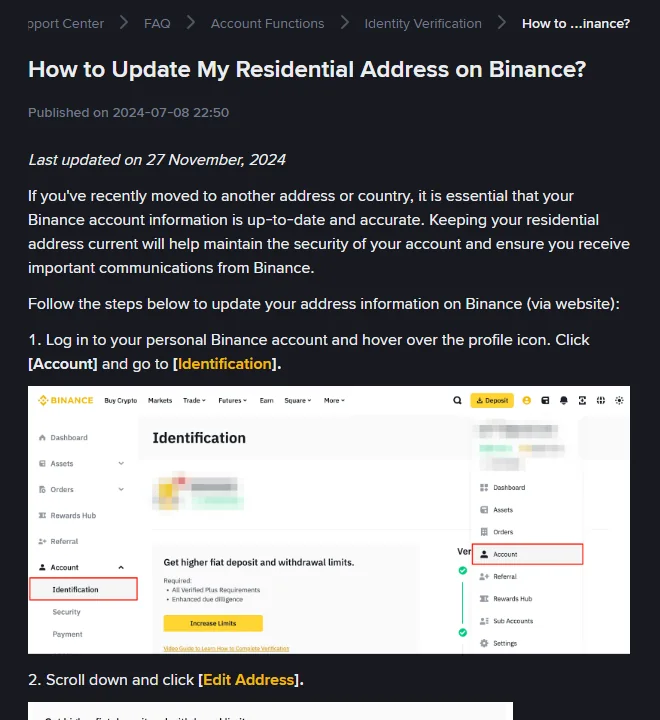
How to change your country of residence on Binance
On the website, step by step:
- Log in, hover over the profile icon, click [Account] and go to [Identification].
- Scroll down and click [Edit Address].
- Select the residential country you are updating to and click [Continue].
- Fill in the address details and click [Continue].
- Follow the instructions and click [Upload] to upload a proof of address.
- Wait. “Your Proof of Address may take up to 1-2 working days to be reviewed.” You are notified of the result, and the page says there is no need to contact support in the meantime.
The document is the part to get right first time.
What the proof of address has to show
The document is checked against five things, listed on Binance’s proof-of-address page: your name, matching the ID you verified with; the home address, matching what you typed; a date of issue; the issuing authority; and something that identifies that authority, such as a logo or a website. It must also be inside the validity window for the new country, which the page sets at 6 months in most places and shorter in a listed group of countries.
What gets refused is as instructive as what passes. Mobile phone bills, payslips, delivery receipts, documents addressed to a PO box, and anything in black and white or photocopied are on the refused list. A paperless bank statement or utility bill downloaded as a colour PDF from the provider satisfies every rule at once. The full accepted and refused lists, with the validity table by country, are in proof of address rejected.
A certificate of residence from local government is on the accepted list. Separately, Binance’s identity update page gives users resident in a listed group of countries a direct link to reset their verification.
What a new country can change on the account
Why Binance may reset your KYC after you move
Binance’s FAQ answers “Why do I have to reset KYC if I just want to update my address?” directly: different countries regulate exchanges differently, and when you move “Binance must ensure that your account complies with the specific regulations of your new residence”, which “might involve resetting your KYC”. If that happens, you go through the document and face steps again, with the same waits as a first verification, and the account may be limited to withdrawals until it clears. The waits are described in how long verification takes.
Futures and other products that disappear after a country change
The same FAQ: “If you change your country of residence, there is a possibility that you may not have access to the same products or might gain access to new ones based on local regulations.” The FAQ does not list which products; if one matters to you, ask support about availability in the new country before you update, not after. Add payment methods from the new country once the residence update has cleared.
If the exchange does not serve your new country
Some destinations are not served at all. Binance’s address page gives one example of a residency change that it says “is not possible in the short term”, and the account’s own notice tells you how your case is treated. For those moves, updating the residence does not open a new door; it tells you which door is now closed. What remains is to withdraw, by the date in any notice, to a wallet or account you control, or to wait for a change in the exchange’s status.
Changing country of residence on Kraken and Coinbase
Kraken’s account information page (updated 3 September 2026) separates two cases. Travelling: “no updates are needed to deposit and/or withdraw funds”. A new residency: sign in on the support site, open the Change Account Info form, choose the account type, choose Address, and attach “a valid proof of address document for the new address”. The page also says that personal details submitted for verification cannot be changed by hand afterwards, which is why the form exists.
Coinbase’s country page is stricter about the state of the account first. A country change “can only be done from your desktop browser and requires a zero cash balance”, open orders and pending transfers have to be closed, an affiliated account affected by the change may have to be closed, and the documents are an updated photo ID plus a proof of address. Coinbase says the change “may affect the services available to you” and that some products “may be restricted in your new country because of regulatory requirements”, which is Binance’s products warning in different words. The common shape across the three: proof of address for the new country, a review, and a product list that changes with the flag.
When the passport and the residence differ
A passport from one country and an address in another is allowed. Verification asks for residence and for the document’s issuing country separately, and both can be true at once.
Binance has extra steps for this case, described on its migrant residents page. After the usual identity verification, the app asks:
- whether you have “visited the specified country within the last 12 months”;
- whether you have “current financial ties or business transactions with the specified country”;
- for your residential address, which must match the proof of address you then upload.
The same page repeats the limit of 10 verification attempts per day. Answer the two questions truthfully.
If your nationality itself changed, that is a separate update with the new passport, covered in updating verified identity details.
Why a VPN or a borrowed address makes a move worse
Using a VPN or a relative’s address to keep the account looking like it never moved is the worst response to a move. Binance’s terms say you “must not attempt in any way to circumvent any such restriction, including by use of any virtual private network to modify your internet protocol address”, and they list identity verification problems among the grounds for restricting an account. A borrowed or old address is also one you cannot back with a proof of address in your name if a review asks for it later.
What to do first when you move country
- Before moving, check whether the exchange serves the destination. If not, plan the withdrawal while everything still works.
- Collect a proof of address in the new country as soon as you have one: a bank statement or a utility bill in your name, dated and within validity.
- Update the residence from the identification settings. Do not change the email, phone or password in the same week; each change adds a withdrawal hold.
- If verification resets, complete it promptly: the account is limited until it clears.
- Check which products are now available, and close positions in any that are not.
- Update the proof of address again if the exchange asks.
Sources · checked October 2026
The update steps, review time, KYC reset and product availability statements, and the short-term residency note are from Binance’s “How to Update My Residential Address on Binance?” (last updated 27 November 2024). Document rules are from “How to Verify My Residential Address on Binance?” (updated 20 April 2026). The questions for migrant residents are from “How to Set up a Binance Account (Migrant Residents)” (updated 19 December 2025). The prohibition on using a VPN to get around a restriction is from the Binance Terms of Use in the 21 July 2026 version we read, which is the one for its Abu Dhabi-regulated entities; other Binance entities publish their own. How to Update My Residential Address is the page the steps above follow, and the one to open on the day you move.
Moving abroad: passports, futures and unsupported countries
Do I have to tell the exchange that I moved?
Yes. Binance's address update page says that if you have recently moved to another address or country it is essential that your account information is accurate, and its terms require true residence details.
My passport is from one country and I live in another. Which do I give?
Both, truthfully. Verification asks for residence and for the document's issuing country as two separate questions. Binance asks migrant residents extra questions about visits and financial ties to a specified country, and takes a proof of address for where you live now.
Will I lose futures or other products if I change my country?
Possibly. Binance's address update FAQ says that different countries have varying regulations and that after a change of residence you may not have access to the same products, or may gain access to new ones. It also says some residency changes are not possible in the short term, and that moving to a new country may require resetting verification to meet local rules.
What if the exchange does not serve the country I moved to?
Then updating the residence does not open a new door; it tells you which door is closed. Binance's address page says some residency changes are not possible in the short term, and its deactivation process leaves withdrawals open for a stated period. What remains is to withdraw, by the date in any notice, to a wallet or account you control, or to wait for a change in the exchange's status. Binance's terms forbid getting around a restriction with a VPN, and a false address is a false declaration.