Before you open a crypto exchange account: what to have ready and what to decide
An eligible residence, an ID that matches it, a camera, an email you will keep and a second factor are what to have ready. The login, the account type, the referral code and the declared country are what to decide before the first screen, because each is hard or impossible to change later.
What to have ready before you sign up
An eligible place of residence. Exchanges serve some countries and not others, and the list moves. Binance checks against your true residence and, under its terms, can also look at citizenship; it publishes a list of prohibited countries, and the sign-up page for your country tells you whether it is served. Other exchanges publish their own lists inside their terms of use; OKX, for instance, keeps a prohibited-jurisdictions section in its affiliate rules and terms. If your country is not served, a different address is not the answer: verification compares the residence you declare with your documents.
A government-issued identity document that matches that residence. A passport, national ID card or driving licence, valid and not expired, with your face on it. The document’s issuing country and your residence are asked as two separate questions, and they can differ: a passport holder living abroad answers both truthfully. What fails is a residence that neither the document nor a later proof of address can support.
A device with a camera you control. Verification includes a live face check with instructions like “no hats, glasses, or filters” and “make sure that the lighting is sufficient”. Binance lets you start on a computer and hand the camera step to your phone by scanning a QR code.
An email address you will still have in five years. It becomes the login, the place where every code and withdrawal confirmation lands, and the address that proves you are you when something goes wrong. Work and school addresses disappear with the job; temporary inboxes disappear faster. Which to pick, and whether a phone number is better, is in email or phone for a crypto exchange account.
A second factor ready to set up. An authenticator app on the phone, or a device that supports passkeys. SMS is a fallback, not a second factor to rely on: it can stop working abroad and does not reach every country. Set this up on day one.
Sign-up choices that are hard to undo later
Which login
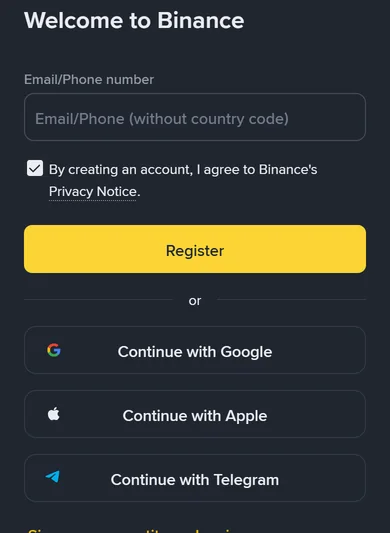
Email or phone, Google, Apple or Telegram. Email plus password keeps the account independent and matches the official instructions step for step. Signing up through Google or Apple is faster but ties the exchange login to that provider. Choose on the basis of which account you are surest of keeping.
Personal or entity
The sign-up page defaults to a personal account; a small link offers an entity (business) account, and the type cannot be changed afterwards. An entity account needs company documents and is not a workaround for a second personal account; see one account per person.
Whether to use a referral code
The code is optional, and it is the only field in the sign-up that is permanent. Binance’s guide says that “once a referral code is linked to your account, it cannot be modified”, and its referral FAQ adds that the relationship “cannot be changed or removed”. A code from a referrer who shares part of their commission lowers your trading fees for as long as the referral programme’s conditions hold, and Binance’s Referral Pro FAQ limits the futures part to a period after the futures account opens and ties rates to the referrer’s tier; a code with no shared rebate gives you nothing and still locks the relationship. So: if you have a code, confirm what it carries; if you do not, decide now whether you want one, because adding it later has conditions and closes at the first deposit. The screen itself, and what each state of the field means, is in the referral step of creating a Binance account, and the rules for adding one later in adding a referral to an existing account.
Which country you declare
You will be asked for your residence at verification, and possibly for proof of it. Declare the country you live in. A false declaration is not checked at sign-up; it meets the documents at verification, or at a later proof-of-address request, and Binance’s terms list identity verification problems among the grounds for restricting an account. The same terms forbid using a VPN to get around a restriction. If you later move, there is an official way to update the residence, covered in updating residence after a move.
What documents a crypto exchange asks for at sign-up
Binance requires all new users to complete its [Verified] level before deposits and trades. The sequence:
- Residence, document issuing country, and document type.
- Photos of the document (front and back for an ID card), taken on the device or handed to the phone by QR code.
- A live face check.
- Confirmation of your personal information. Binance warns: “You won’t be able to change it once confirmed.”
- A review, “usually within 48 hours” in Binance’s words, with a notification at the end.
Binance’s help pages allow up to 10 attempts a day; after 10 refusals within 24 hours, you wait 24 hours. What the review looks for and why submissions fail is in verification failed or ID rejected.
Binance’s page also says the verification level sets the account’s trading limit, and that depending on your region or payment channel you may need to raise it; a proof of address is one of the documents a higher level can ask for. A new account does not need more until something asks for it.
Do you need a deposit, a bank account or the app to sign up?
Sign-up does not need a deposit, a bank account, or a card; the account exists before any money is involved, and the first deposit is a separate decision. It does not need a referral code; the field is optional, and the only reason to fill it is the fee rebate a good code carries. It does not need an app; signing up on the website or in the app produces the same account, and Binance’s two guides describe the same screens. And it does not need anyone else: no agent, no intermediary, no person who “opens accounts” for a fee. Anyone offering to register or verify an account on your behalf is offering an account verified in someone else’s name, which Binance’s verification page rules out.
What to decide about money, before any goes in
None of this is an exchange rule; it is habit that keeps mistakes cheap.
- Start with a small deposit and a small withdrawal before anything larger.
- Decide where the records will live. Exchanges let you download transaction history, which is what you will need for any later question about the account. A closed account’s history is only what you downloaded before closing; see export your trade history before closing.
- Turn on the withdrawal address whitelist from the start, so withdrawals go only to addresses you have saved.
Sign-up readiness checklist
| Item | Ready when |
|---|---|
| Residence | The exchange serves it, and you can prove it with a document in your name if asked |
| Identity document | Valid, government-issued, face visible, issuing country known |
| Camera | On a phone or computer you own, with permission to use it |
| A personal address at a major provider that you will keep | |
| Second factor | Authenticator app installed, or a device with passkey support |
| Login choice | Made, and the password is new, not reused |
| Account type | Personal, unless you are registering a company |
| Referral code | Known and checked, or deliberately declined |
| Declared country | The one you live in |
Sources · checked October 2026
Account type, referral and 2FA statements follow Binance’s “How to Register on the Binance Website?” (updated 24 November 2025); verification steps and the 48-hour figure follow “How to Complete Identity Verification for a Personal Account?” (updated 5 June 2026); the 10-attempt limit follows Binance’s identity verification FAQ on its blog and the migrant residents page (updated 19 December 2025). Eligibility by residence and citizenship, and the minimum age, follow the Binance Terms of Use in the 21 July 2026 version we read, which is the one for its Abu Dhabi-regulated entities; other Binance entities publish their own. Start from How to Complete Identity Verification if you want the requirements in Binance’s own words.
Eligibility, age and documents: what people ask before signing up
Can I open a crypto exchange account with just a passport?
For the identity step, a passport is one of the options most users get: Binance's verification page says most users can choose a passport, an ID card or a driver's license, with the options depending on the issuing country, and the document has to be valid. A higher verification level may also ask for a separate proof of address, which cannot be the same document used for identity. Binance's verification page lists the accepted types once you pick the issuing country.
Does the exchange check my citizenship or only where I live?
Both can matter. Binance's terms set eligibility by reference to being located in, resident in, or a citizen of a prohibited jurisdiction, and its referral terms exclude users in restricted regions. During verification you choose your residence and the document's issuing country separately. Declaring a country you do not live in breaks the terms, and a later proof-of-address request is where it shows.
Is there a minimum age?
Yes. Binance's terms of use require an individual to be at least 18, or the age of majority where you live if that is higher, and verification compares the date of birth on the document with that requirement.
What if Binance does not serve my country?
Then no document or address gets you in. Binance checks eligibility against your true residence and, under its terms, can also look at citizenship; it keeps a list of prohibited countries, and the sign-up page and verification steps tell you when a country is not served. A false residence is not a way around it: it breaks the terms and does not match the documents verification asks for.