Can an existing Binance account add or change a referral code?
Does the account already have a referrer? Then it cannot be changed or removed. Never had one? Then official routes remain, each with conditions: bind within 30 days, self-rebind if it has never traded, be recalled after 90 inactive days, or apply to rebind. Closing the account to start over is refused by the rules.
- It has a referrer. It cannot be changed or removed. Binance’s referral FAQ: “once the referral relationship has been established, it cannot be changed or removed.”
- It has never had one. Within 30 days of registration and before any deposit, bind on the referral binding page. If it has deposited but never traded, self-rebind through an affiliate’s rebind link. After 90 days of registration and 90 days of not using the platform, accept an affiliate’s recall link. If the account has traded, but under 5,000 USD in the last 90 days, submit a rebind application, which only takes effect once you trade 150,000 USD within 30 days.
- Close it and register again with a new code. The FAQ’s answer is “No”, and it describes what happens to accounts that try.
Not sure which applies? The referral code checker asks five questions and tells you which option fits the account. Leave [Close Account] alone until you have checked.
Six account situations and what each can do
| Your account | What is possible | Official source |
|---|---|---|
| Registered with a code, or through someone’s link | Nothing can be changed | Referral Pro FAQ, “can I change or remove my referrer?” |
| No referrer, registered less than 30 days ago, no deposit or trade yet | Enter a code on the referral binding page | Referral Pro FAQ, “can my referrals use my code after creating their accounts?” |
| No referrer, registered more than 90 days ago, no trade or product use in the last 90 days | Open an affiliate’s recall link, log in, confirm the pop-up | Affiliates Recall Program FAQ |
| No referrer, has deposited but never traded | Self-rebind through an affiliate’s rebind link, with no application and no volume condition | Affiliates Rebind Feature FAQ, question 17 |
| No referrer, has traded, under 5,000 USD volume in the last 90 days | Submit a rebind application; it takes effect at 150,000 USD of volume within 30 days | Affiliates Rebind Feature FAQ |
| No referrer, over 5,000 USD volume in the last 90 days | Not for now; wait until your 90-day trading volume falls below 5,000 USD (other ways fees come down) | Same |
Not sure whether the account has a referrer? Ask through the official support entry in the app rather than relying on memory, and do not enter your login on a third-party “check my referral” page.
A referrer is whoever’s code the account was linked to; an affiliate is a referrer accepted into Binance’s affiliate programme, with its own link format and rules. Recall only works through an affiliate’s link, and both kinds of rebind through an affiliate’s link or code; the 30-day binding page takes any valid code.
Why an existing referrer cannot be changed
The referral FAQ’s question 6 asks, as a referee, whether you can change or remove your referrer. The whole answer is: “No, once the referral relationship has been established, it cannot be changed or removed.”
There is no exception clause. The answer has no carve-out for a referrer who deactivated the code, left Binance or shared no rebate with you, and none of the referral pages offers a way to request a change.
The relationship is a money split. The referrer takes a share of the trading fees you pay, and decides when creating the code how much of that share to pass back to you. The FAQ says a link’s settings “cannot be modified” once created, which is why the referrer cannot improve your rate later either.
If you are in this group and want lower fees, the options that remain have nothing to do with referrals: paying fees in BNB and reaching a VIP tier.
Registered without a code: binding within 30 days
This route exists for people who forgot the code at sign-up. Question 4 of the referral FAQ says such users “can complete the referral binding process here”, and lists who qualifies. All six conditions must hold:
- Your identity details have not been used on another account within the past 180 days.
- The account has no existing referral relationship.
- The account is a parent account, not a sub-account.
- You are within 30 days of registration.
- The account has no deposit or trading activity.
- You are not flagged as a wash trader.
Read conditions 4 and 5 together. Binding has to happen before the first deposit, not just within the month. One small purchase and the page refuses.
The operation is short. Log in, open the binding page at www.binance.com/en/activity/referral/bind-ref, enter the code, confirm. If you meet the six conditions and have no code to hand, you can use this site’s: ZY1818. Using it does not raise your fees; Cobalt Desk may earn a commission from the fees Binance collects, and the share returned to you is up to 20%*. Check the characters before confirming, because this binding also cannot be changed.
If the page reports that the account is not eligible, go down the six conditions, starting with whether there has been any deposit or trade. Resubmitting does not help; check whether recall or a rebind fits the account instead.
Inactive account, never had a referrer: the Affiliates Recall Program
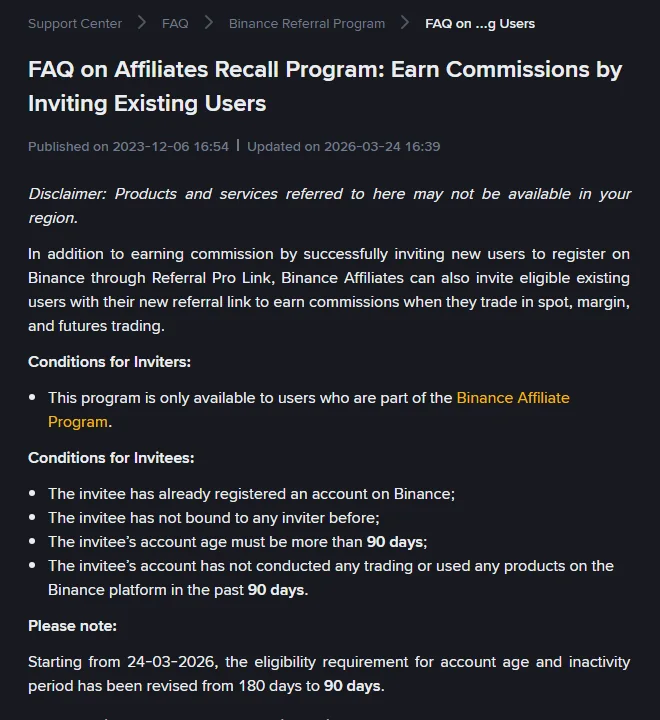
The second route is the Affiliates Recall Program. It lets Binance Affiliates use their new-format referral link to invite existing users. The FAQ lists four conditions for the invitee, all required:
- already registered on Binance;
- has “not bound to any inviter before”;
- account age “more than 90 days”;
- no trading and no use of any product on the platform “in the past 90 days”.
The FAQ carries a note: “Starting from 24-03-2026, the eligibility requirement for account age and inactivity period has been revised from 180 days to 90 days.” Pages that still say 180 days are describing the old rule.
Recall works through a link, not a code. The FAQ states that “binding the referral relationship with existing users through a referral code is not supported”, and that only the affiliate’s new link or QR code, in the format binance.com/join?ref=XXXXXXXX, covers both new and existing users. The sequence, in the FAQ’s words: the eligible invitee opens the link, logs in, “a confirmation window will pop up”, and clicks [Bind Now].
Whether the recall pop-up appears after you log in is decided by Binance’s own checks. The four steps:
- Open an affiliate’s new-format link. If you have none, this site’s referral link takes you to Binance through a link in that format; as with the code, using it does not raise your fees, and if the referral programme is closed where you live, do not use it. The link lands on the sign-up page. That is expected; do not register.
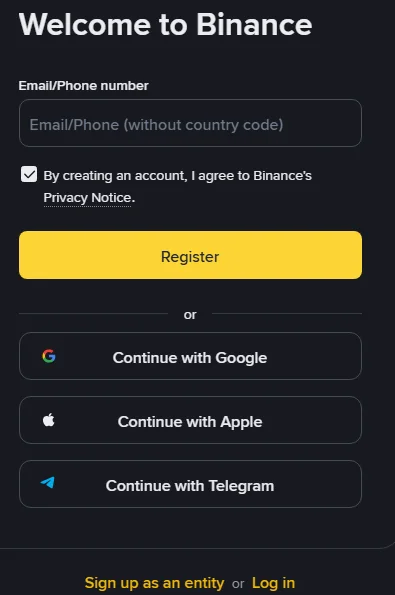
- Find “Log in” in the small line at the bottom of the sign-up form and go to the login page.
- Log in to the existing account that meets the four conditions, including its 2FA.
- After login, a window asks whether to bind to this referrer. Press [Bind Now].
Step 1 is where this most often goes wrong. The sign-up page’s biggest elements are the email field and the yellow [Register] button; fill those in and you have created a second account, which has nothing to do with recall and will collide with the first at verification. The target is the “Log in” link under the form.
If no window appears after login, go back over the four conditions; the FAQ also says the feature may not be available in every region. Do not keep retrying, and do not register a new account to force it.
Read the conditions closely.
“Used any products” is wider than “traded”. The condition is no trading and no use of “any products on the Binance platform” in the past 90 days. The FAQ does not list the products; read as written, an Earn subscription, an auto-invest plan, copy trading or a trading bot that ran in that period would count as well as spot and futures orders. Whether logging in to look at a balance counts is not stated.
Only for accounts that never had a referrer. Recall is for an account with no referrer, not for one that wants a different referrer.
Not every region. The FAQ opens with a disclaimer that the products “may not be available in your region”, and ends by saying the feature “is still in the testing phase” and “may not be available in all regions”. A missing pop-up can mean that rather than an ineligible account.
Active account, never had a referrer: the rebind application
The third route got its own help page on 28 September 2026. The Affiliates Rebind Feature is for users who “already have trading history and require additional eligibility checks”. The applicant must meet all of:
- identity verification completed, and account review finished;
- “do not have an existing referrer”;
- a master account, not a sub-account;
- total trading volume “below 5,000 USD (or equivalent) in the last 90 days”;
- not flagged for abnormal trading or conduct against the terms;
- not resident in a country or region where the referral programme is not supported.
The same page separates two groups. Question 17 says “self-rebind is available for users with no trading history”, and that the application “is for users who already have trading history and require additional eligibility checks”. An account that has only ever deposited, or never been used at all, is in the first group: it binds through the affiliate’s rebind link without an application, and the 150,000 USD volume condition does not apply to it. The application and that condition are for accounts that have traded.
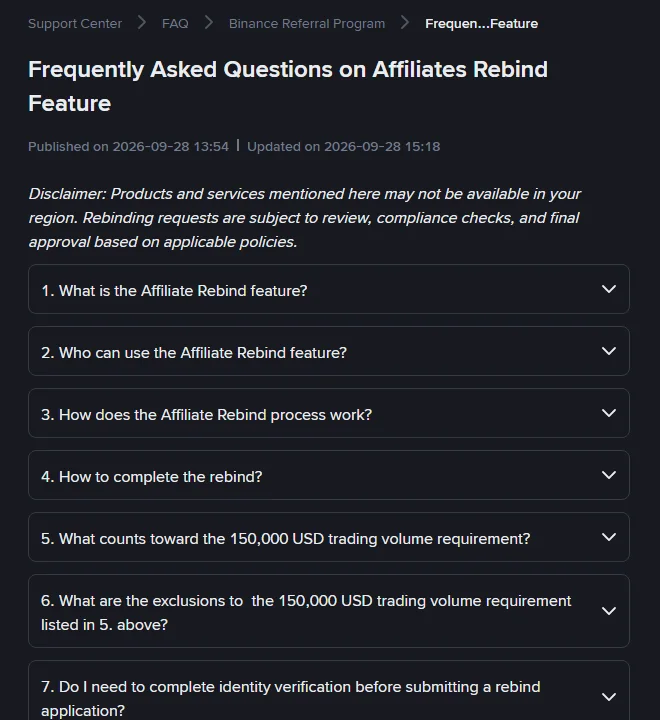
There is a second hurdle after submission. The FAQ: “the referral relationship will be established once the user reaches a total trading volume of 150,000 USD (or equivalent) within 30 days.” The clock starts on the submission day; reaching the figure earlier completes the binding “on the same day”. Spot, futures, convert, margin and copy trading count. Sub-account volume and zero-fee pairs do not.
The FAQ describes two ways in: an affiliate’s rebind link, which pre-fills the code, or entering and confirming a valid referral code on the rebind page yourself. Either way the code has to be an affiliate’s, because Binance says only affiliates can initiate the application, and either way “you still need to review and confirm the submission yourself”. The volume condition is the same whichever affiliate’s code is used.
Do the arithmetic before applying. Suppose the fee is the regular spot rate of 0.1%. Then 150,000 USD of volume means 150,000 × 0.1% = 150 USD in fees. Trading that volume only to bind a code costs more in fees than the rebate returns for a long time afterwards. The route makes sense for someone who trades at that scale anyway, had a quiet 90 days, and is about to resume. The fee rate is an example; your actual rate is on Binance’s fee page.
A failed application can be resubmitted and is reviewed again each time. You cannot apply while one is in progress, or if the 90-day volume has risen above the threshold. You cannot cancel one yourself; the FAQ says to contact support.
If the account traded more than 5,000 USD in the last 90 days and is more than 30 days old, none of the three routes applies for now. The only move is to wait for the 90-day figure to drop.
Closing the account to register with a new code
Closing and reopening is the advice that circulates on forums and in group chats. Binance addresses it in two places.
Question 7 of the referral FAQ: “Can I close my current Binance account and register for a new account with a new referral code?” Answer: “No, if the system detects that an account has been closed to create a new one for referral benefits, Binance reserves the right to terminate all referral commissions from the new account.” Question 8 explains how the detection works: a new account registered with the same identity information is identified as a duplicate identity, “commissions from this user will be terminated, and the user will also be ineligible to receive any rebates.”
The account closure page lists the cost on the user’s side:
- “Account closure is irreversible.”
- “If you create another account after this closure, your identity verification may be blocked for 30 days or longer.”
- A new account “with a different referral relationship than your current account” loses “eligibility for any referral rebates”.
- The new account also loses “eligibility to participate in activities and receive rewards”.
So the outcome of closing to re-register is: the old account is gone, its history is only what you downloaded before closing, verification on the new account may wait a month or more, and the rebate you did it for is the one thing the rules say you will not get. The wording is “reserves the right”, which means Binance decides when to check; building a plan on not being checked is not a plan.
Using a relative’s document for a second account, or re-verifying after closure with a different document type, are in the same category. The verification page says you cannot transfer an account or use another person’s ID. An account verified with a relative’s document is in their name: a later face check or an account recovery needs their face and their document, not yours.
If you want to close the account for an unrelated reason, that is a normal operation: the checklist and steps are in how to close a Binance account, and what happens to the same ID afterwards, across three exchanges, is in re-registering with the same ID.
How to check that your Binance referral code is linked
After the binding page accepts a code, or [Bind Now] is pressed in the recall window, the proof is in the money. The rebate is paid after the fact: Binance charges the full fee, then returns the agreed share. The referral FAQ says the default token is USDC, calculated hourly, with the converted amount deposited in the Spot account within 6 hours.
There is no need to trade in order to check. Wait for the next fee-paying spot trade you were going to make anyway, then look in the Spot account’s transaction history a few hours later for a rebate entry. If it is there, the relationship is live, and the share equals the rebate divided by the fee on that trade. If nothing appears a day later, ask official support, quoting the trade time and order number. If you have no trade planned, ask support about the account’s referral status directly.
A bound account can show no rebate without anything being wrong: the referrer created the code without sharing any of the commission; or the trade was in futures and the futures rebate period has expired, which the FAQ says happens after the referrer’s one-year futures commission limit unless the referrer has reached the 30% tier.
Binance referral code not working or invalid: the reasons Binance gives
Binance’s pages give several reasons a code is refused.
- The account already has a referrer. Binance’s sign-up guide says “once a referral code is linked to your account, it cannot be modified”. A second code is refused however it is entered. See why an existing referrer cannot be changed.
- The 30-day window has closed. The binding page takes a code only within 30 days of registration and before any deposit or trade. See binding within 30 days.
- The identity was used on another account. The first binding condition is that your identity details have not been used on another account within the past 180 days.
- It is a sub-account. Binding and rebinding both require a parent or master account. See sub-accounts and entity accounts.
- An older account tried a code where only a link works. The recall FAQ says binding existing users “through a referral code is not supported”. See the Affiliates Recall Program.
- The referral programme is not open where the account is registered. Binance’s referral notes say users in restricted regions cannot take part as referrers or as referred users. Binance’s own lists are linked from the disclosure page.
- At sign-up, the code was mistyped. Binance’s sign-up guide says that if the code is invalid “you may edit it or enter another one”. Check for a stray space, or a letter O typed as a zero; the referral screen shows the three states of the field.
Common claims about changing a Binance referrer, checked against the FAQ
| Claim | What the official pages say |
|---|---|
| A code can never be added after registration | Outdated. Within 30 days, before any deposit or trade, the binding page accepts a code, subject to the other four conditions |
| 180 days of inactivity lets an old account rebind | Old rule. The recall FAQ changed account age and inactivity to 90 days on 24 March 2026, and recall only works for accounts that never had a referrer |
| Trade 150,000 USD and you can switch referrer | Half right. That is the completion condition for a rebind application, which is for accounts with no referrer, trading history, and under 5,000 USD of 90-day volume; an account with no trading history self-rebinds without it. An account with a referrer cannot switch at any volume |
| Go to Account, then Referral, and type the new code | None of the referral, recall or rebind pages describes such a menu. The documented path is the binding page |
| Support can change the referrer within 24 hours | None of those pages gives support that power; the only support action in the rebind FAQ is cancelling an application |
| Close the account, wait two weeks, re-verify, keep the rebate | Contradicted by the closure page (verification may be blocked 30 days or longer) and the referral FAQ (no rebate for a new account with a different relationship) |
| Re-verify with a different document and the system will not notice | The system matches identity information, not document type, and the verification page forbids substituting another person’s ID |
| Any referral link works for recall | Only an affiliate’s new-format link triggers it; the FAQ says codes are not supported for existing users |
There are two different 180-day figures. The binding page’s 180 days is about identity details used on another account, aimed at people who recently closed an account. It has nothing to do with how long an account has been idle.
Can a sub-account or entity account use a different referral code?
A tempting workaround: the main account’s referral is fixed, so open a sub-account or an entity account and bind a different code there.
Sub-accounts do not have their own referral. Question 9 of the referral FAQ: “Sub-accounts cannot invite new users, but their trading commissions will be credited to the master account’s referrer.” Both the binding and rebind conditions also require a parent or master account.
An entity account is a different account type that needs a business’s documents. Going through a corporate verification to capture a share of trading fees costs far more than the rebate. How many accounts one person can hold, and of what kind, is in one account per person.
Offers to change a Binance referrer for a fee
Because the official answer is “no”, there is a market in people who say otherwise. The offers come in these shapes:
- “Support” or an “insider” with a special channel to edit the relationship, who needs your login code or wants you to sign in on a page they send. Whoever has that code has the account.
- A paid service that takes a fee and then tells you to close and reopen, leaving you with the consequences above.
- A copied binding page, one or two characters off the real address, that harvests logins.
Every real way to add a referral code happens while you are logged in on Binance’s own pages, by your own confirmation, with no payment and no code shared with anyone. Any address, email or Telegram handle can be checked on Binance Verify at binance.com/en/official-verification; the page itself says Binance “will never request funds or tokens via private communications.”
Lower Binance trading fees without changing the referrer
If the account is in the “cannot change” group, stop spending time on the referral and look at the ways to lower fees that work regardless of it.
- Pay fees in BNB. Under [Fee Level] there is a toggle to pay fees with BNB at up to 25% off. Binance’s fee page lists the regular spot rate as 0.1000% and the rate with the BNB discount as 0.0750% (checked October 2026). It works whether or not the account has a referrer.
- VIP tiers. Fee rates fall with volume and holdings. The first step above regular, VIP 1, needs 30-day spot volume of at least 1,000,000 USD and at least 5 BNB held (fee page, October 2026). For most people it is a fact to know, not a target to trade towards.
- Fewer trades. Fees are charged on every fill, so every round trip you skip saves its whole fee, rebate or not.
Adding a referral code to an existing Binance account: what to try first
- Confirm through official support whether the account has a referral relationship. If it does, stop here and look at fees instead.
- No referrer: check the registration date. Under 30 days, no deposit, no trade: use the binding page.
- Past the 30 days, deposited but never traded: self-rebind through an affiliate’s rebind link; no application, no volume condition.
- More than 90 days old, no trade or product use in 90 days: open an affiliate recall link and log in.
- Has traded, under 5,000 USD of 90-day volume, and about to trade more than 150,000 USD in the next 30 days anyway: submit a rebind application.
- None of the above: do nothing yet, and check the 90-day volume again next month.
- In every case: a binding cannot be undone, so check the code before confirming.
Sources and check date · checked October 2026
Four Binance help pages are the main sources: “Frequently Asked Questions on Binance Referral Pro Mode” (updated 5 August 2026), “FAQ on Affiliates Recall Program” (updated 24 March 2026), “Frequently Asked Questions on Affiliates Rebind Feature” (published 28 September 2026) and “How to Close My Binance Account?” (updated 3 September 2026), plus the personal-account identity verification page and the spot fee schedule. Conditions are quoted or closely paraphrased from those pages. The binding page shows its contents only after login, so its exact on-screen wording may differ from the description here. All of these pages have changed within the last year; before acting, re-read the referral FAQ and the rebind FAQ.
Follow-up questions about binding, recall and starting over
I entered a referral code years ago. Can I switch to a better one now?
No. Binance's referral FAQ answers the question directly: once the referral relationship has been established, it cannot be changed or removed. It does not matter whose code it was or whether it carried any rebate. Every route for adding a code, including recall and rebind, requires that the account has never had a referrer.
If I close my account and register again with a new code, will I get the rebate?
Not under the rules. The referral FAQ says that if the system detects an account was closed to create a new one for referral benefits, Binance reserves the right to terminate all referral commissions from the new account, and that a new account created with the same identity information is treated as a duplicate and receives no rebate. The account closure page adds that verification on the new account may be blocked for 30 days or longer.
Is it still 180 days of inactivity for the recall programme?
No, 90 days. The recall FAQ states that from 24 March 2026 the account-age and inactivity requirements were revised from 180 days to 90 days. The 180 days that still exists is a different condition on the 30-day binding page: the identity details must not have been used on another account in that period.
Does recall work with a referral code typed by hand?
No. The recall FAQ says that binding an existing user through a referral code is not supported; only an affiliate's new-format referral link or QR code triggers the confirmation pop-up after login. A code typed on the binding page is the 30-day route, which has its own conditions.
Can support change my referrer for me?
None of Binance's referral, recall or rebind pages gives support that power. The only mention of support in the rebind FAQ is for cancelling a rebind application. Anyone who offers to change a referral relationship for a fee, or asks for a code to do it, is not following any Binance process.