When a crypto exchange account holder dies, the estate claims the assets
The person appointed to handle the estate files a claim with the exchange, attaching the death certificate, the court papers that name them, their own identity document and a letter saying where the assets should go. Binance, Kraken, Coinbase and Bitget all publish this route; Kraken and Coinbase say in writing that there is no beneficiary option, and Binance and Bitget describe only the claim after the death. Nobody has to know the password, and the family should not log in.
After the claim, the exchange moves the balance where the estate instructs, or closes the account, from its own side. Where the four exchanges differ is the door you knock on, how strictly the documents have to be certified, and whether a timeline is published at all.
| Exchange | Where the claim starts | Documents named on the page | Timeline stated | Beneficiary option |
|---|---|---|---|---|
| Binance | The Inheritance Appeal form, under Customer Support, Self Service, Legacy Inheritance; the claimant needs a Binance account of their own | “Legally valid inheritance documents”; the deceased’s email, phone number or Binance ID | “Around 1 - 2 months”, longer in complex cases | Not described |
| Kraken | A claim submitted through the support site | Death certificate, legal appointment document, photo ID of the representative, signed letter | None | “Doesn’t currently offer the option to add a beneficiary” |
| Coinbase | The Executor Services form, from a Coinbase account of the claimant’s own | Death certificate, probate documents, photo ID of the person named in them, signed letter of instruction | None | “Doesn’t currently support naming a beneficiary for individual accounts” |
| Bitget | The Inheritance Application, under Support, Self-service, Account; the applicant logs in to their own Bitget account | Death certificate, proof of identity of the deceased, proof of the applicant’s identity, proof of heirship; the deceased’s user ID or registered email | “Typically” one week, longer in complex cases | Not described |
What the executor needs to claim the account
Across the four exchanges the list is much the same, under slightly different names.
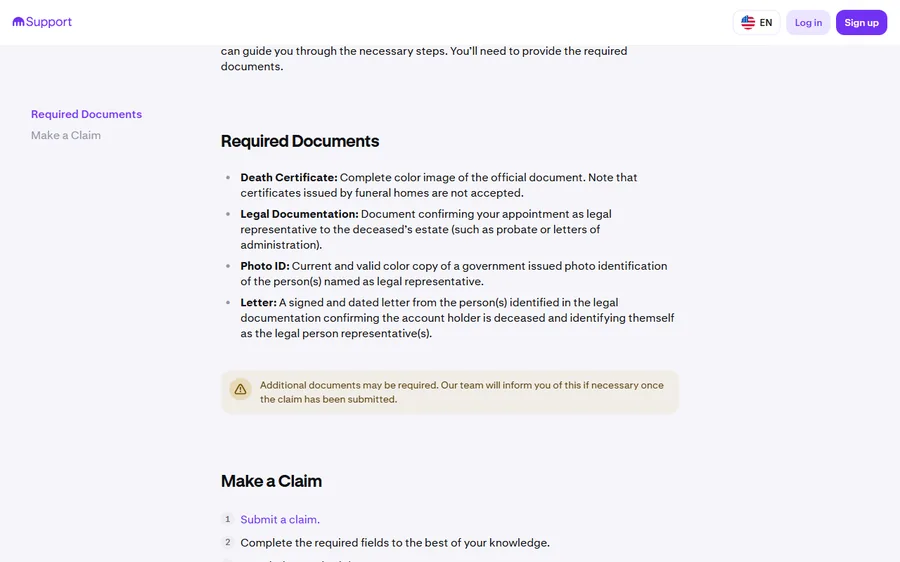
- Proof of death. All four ask for the death certificate. Kraken is the strictest about the form: a “complete color image of the official document”, and “certificates issued by funeral homes are not accepted”.
- Proof of authority. A court or official document that appoints the executor or administrator; its name and form differ by country. Coinbase lists several such documents by name, Kraken gives “probate or letters of administration” as examples, and Bitget asks for proof of heirship, “for example, a valid will, testament, proof of relationship, or other documents establishing your legal right to inherit”. This is the document the family does not have on the day of the death and the one that sets the real timeline.
- The claimant’s own identity document. A current, valid, government-issued photo ID of the person named in the court papers, on all four.
- A signed letter of instruction. Kraken and Coinbase each want a letter signed by the representative saying what should happen to the assets; Coinbase specifies the destination account “including its associated email address”.
- Something that identifies the account. Binance asks for the deceased’s registered email, phone number or Binance ID, and says any one of them is enough. Bitget asks for the deceased’s user ID or registered email, plus proof of the deceased’s identity.
Expect the list to grow once a claim is open. Kraken puts it plainly: “Additional documents may be required. Our team will inform you of this if necessary once the claim has been submitted.”
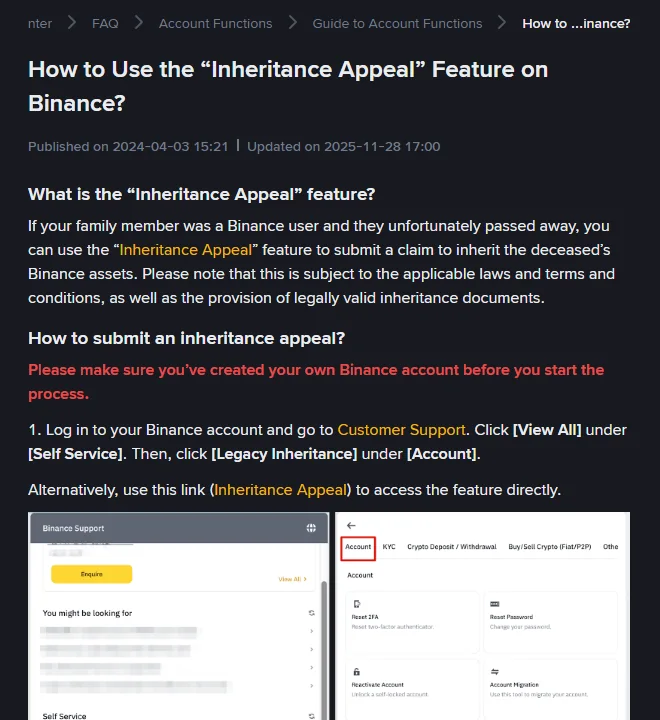
Binance: the Inheritance Appeal form
Binance’s page is short and the sequence is specific. The claimant first creates a Binance account of their own, because the form lives inside the logged-in support area. Then: Customer Support, [View All] under [Self Service], and [Legacy Inheritance] under [Account]. The form asks for the deceased’s email address, phone number or Binance ID (“providing any one of these will be sufficient”), the claimant’s details, and the inheritance documents as attachments. After [Submit], “a dedicated team will review your application”.
Binance and Bitget are the two of the four that commit to a duration. On Binance, the transfer to “the rightful beneficiary or trustee” usually takes “around 1 - 2 months”, and “sometimes it may take longer in more complex cases”. Treat the two months as the exchange’s part. The court’s part comes before it.
Kraken: a claim through the support site
Kraken’s page says the process is run by “our Compliance team” and promises to handle it “with care and discretion”. The claim itself has three steps: submit a claim through the linked form, “complete the required fields to the best of your knowledge”, and attach the four documents listed above. There is no stated review time. The page’s one unusual line is the warning that certificates issued by funeral homes are not accepted; the certificate has to be the official document.
Coinbase: the Executor Services form
Coinbase, like Binance, routes the claim through an account belonging to the claimant: “Sign in to your Coinbase account. If you don’t have one, create one.” From there the Executor Services form takes the documents, the required fields, and a verification code the form generates; the page says to “follow the instructions on the form carefully to verify your request”, after which “you will receive support for your case”. The letter of instruction has to name the account the assets should go to, with its email address, so decide where the estate wants them before filing.
Coinbase also says the thing the other pages imply: ownership passes under the estate planning documents or, where there are none, under the inheritance law that applies. The exchange follows the court, not the family’s wishes.
Bitget: an Inheritance Application from your own account
Bitget’s route looks like Binance’s. The applicant logs in to their own Bitget account, opens the Support page, clicks View All under Self-service, and selects Inheritance Application in the Account section. The form asks for the deceased user’s Bitget user ID or registered email, the four documents listed above, and an “Additional information” field where any missing document has to be explained: “All required documents must be provided for the application to be reviewed.” A confirmation box comes last, and the page calls it “critical for the review process”.
Once the application is approved, “the assets will be transferred to the verified heir”. Processing “typically takes one week, depending on the complexity of the case”. The page warns that inaccurate or inconsistent information “may delay the review process or result in rejection of the application”, so match every detail to the documents before submitting.
Why nobody should log in as the account holder
The temptation is obvious when the family knows the password or has the phone. The reasons not to are in the exchanges’ own rules. Every account is verified to one person, the rule set out in one account per person; Binance’s deactivation page states that “each customer is only allowed to have one verified Binance account”, and a withdrawal made by someone who is not that person is, from the exchange’s point of view, an unauthorised withdrawal. Kraken’s closure page describes the kind of check involved: a withdrawal “placed on hold for manual review as a security precaution” to make sure funds go only to “an account owned and controlled by the client”. A login by someone else is the situation such checks exist for.
The second reason is the estate itself. The balance is part of it, and a transfer out before the representative is appointed is one the representative may later have to account for. The claim routes above avoid that.
What the executor can do before the court papers arrive
The claim cannot be filed until the authority document exists; where that is a court appointment, it can come weeks or months after the death, and the exchanges’ own lists do not shortcut it. The interval is for preparation, not for action on the account.
- Find out which exchanges there were. Confirmation emails, app icons on the phone, bank statements showing transfers to or from an exchange. Note the email address used for each.
- Order the death certificate in the form the exchanges accept: an official copy, in colour.
- Leave the phone and the email account alone except to preserve them. Do not wipe or recycle a phone that held an authenticator app; nothing in the four pages requires it, but the estate may need the email account to receive the exchange’s messages.
- Do not fund the account, trade on it, or let anyone else do so. Binance’s deactivation page says deposits into a deactivated account “will not be credited and may result in permanent losses”.
- Decide the destination now: a bank account in the estate’s name, or a wallet the estate controls. Kraken and Coinbase ask for it in the signed letter.
Planning ahead: can you name a beneficiary on your own account?
None of the four pages describes a way to pre-authorise a person to take over, and two say outright that there is no beneficiary option. What you can do is make the claim easy to start: a list of the exchanges you use and the email address on each, kept with your will or with whoever will handle your estate. Keep the statements you export from each exchange with those papers too, as described in export your trade history, because the estate will not be able to generate them later. Do not write down passwords or two-factor codes for them to use; Binance’s terms, for one, forbid giving anyone else access to the account. The estate will get the assets through the form, with the exchange doing the moving.
Exchange help pages used · checked October 2026
Binance’s route and its one to two month estimate are from How to Use the “Inheritance Appeal” Feature on Binance? (updated 28 November 2025); the one-account and deposit statements are from “Why Did I Receive an Account Deactivation Notice?” (updated 13 May 2026). Kraken’s document list, its warning about funeral-home certificates and its manual review of withdrawals are from Deceased Client Account Claims (updated 17 March 2026) and “Account Closures: Safeguarding Our Clients and Kraken” (updated 28 September 2026). Coinbase’s list and the Executor Services steps are from “Claim a decedent’s Coinbase account”, which shows no update date. Bitget’s application route, documents and one-week estimate are from How to Submit an Inheritance Application on Bitget? (dated 4 March 2026). Inheritance law differs by country; these pages describe the exchanges’ procedures, not what the court will decide.
Who can claim, how long it takes, and whether it can be avoided
Can a family member log in with the password and withdraw the balance?
No. Each of these exchanges ties the account to one verified person, and Binance's terms, for one, say the account is for the holder's own use. The route the exchanges publish is a claim filed by the estate's legal representative, with the exchange moving the assets itself.
How long does an exchange inheritance claim take?
Binance says around one to two months, and Bitget usually within one week; both say complex cases take longer. Kraken and Coinbase publish no figure. The proof of authority or heirship comes first on all four: usually a court appointment, or another official document where the law of the place allows it; Coinbase lists several, and Bitget gives a will or proof of relationship as examples.
Can I name a beneficiary on my own exchange account now, to spare my family this?
Kraken and Coinbase say in writing that they do not offer a beneficiary option, and Binance's and Bitget's pages describe only a claim made after the death. What helps instead is leaving the exchange's name and the email address on the account where your executor will find them, together with your other estate papers.