A crypto exchange closed your account: what you can still do
Find the date in the notice, then withdraw. When an exchange closes an account on its own initiative, what keeps working is the way out, and it differs: a crypto withdrawal on Binance, a fiat withdrawal after converting on Kraken, a cash withdrawal or a crypto send on Coinbase. Trading and deposits stop, the reason is usually not shared, and where an appeal exists it is a second review rather than a negotiation.
Withdraw first, and check whether your crypto has to be converted before it can leave: Kraken requires converting to fiat, Coinbase does not convert for closed accounts, and Binance converts only small balances to BNB. Where a date is set, such as Binance’s deactivation date or OKX’s 30 days to supply a wallet address, nothing on the exchanges’ pages says an appeal pauses it.
| Binance | Kraken | Coinbase | OKX | |
|---|---|---|---|---|
| How it arrives | An “account deactivation notice” by email, with a deactivation date | Account closed “following a thorough internal review”; services “immediately disabled” | Prompted to withdraw on signing in, after “violating the user agreement” | Terms allow termination “at any time and for any reason” and a request for a wallet address |
| What still works | Crypto withdrawal only, until the date | Fiat withdrawal to a previously linked bank account in your name | Cash withdrawal to a verified bank account, or sending crypto off the platform | Return of funds “less the value of any trading fee discounts, rebates, costs, expenses and/or damages” |
| Can you convert first? | No, except small balances to BNB | You must: “convert them to fiat currency before initiating a withdrawal” | No: “does not provide conversion services for closed accounts” | If no wallet address is given within 30 days, OKX liquidates and returns to a linked bank account |
| Reason given? | “May not be able to share the reason” | “We cannot disclose any details” | Not described | “Sole discretion” |
| Appeal | Contact support; concerns “forwarded to the appropriate team for further review” | “Generally final”; support “can escalate your case for a second review” | Not described on the closure page | Not described in the terms |
| New account | No: one verified account per customer | “Not permitted”, unless the appeal succeeds | Not described | Users warrant they “have not previously been suspended or removed” |
The withdrawal window, exchange by exchange
Binance gives the clearest timetable. The notice names a deactivation date, and the page says to “withdraw your funds in full” before it. Until then, withdrawal is the only product left: P2P, Pay, deposits, trading, convert, API, referrals, futures, Earn, NFT and the Web3 wallet are all listed as unavailable. After the date the account is deactivated and the page warns against sending anything in: new deposits “will not be credited and may result in permanent losses”. The ordering problems are all on the page as well. Withdraw NFTs before the last of the crypto, because they need gas; close derivatives positions yourself, because afterwards “any remaining open positions will be closed progressively” with regular fees; repay loans before the date, because afterwards they are “liquidated progressively at the prevailing market price” with a 2% liquidation fee; redeem Earn positions, and ask support to redeem the ones that cannot be redeemed by hand. Small balances that cannot be withdrawn can be converted to BNB, the one conversion allowed. Fiat balances that cannot be withdrawn are a support case.
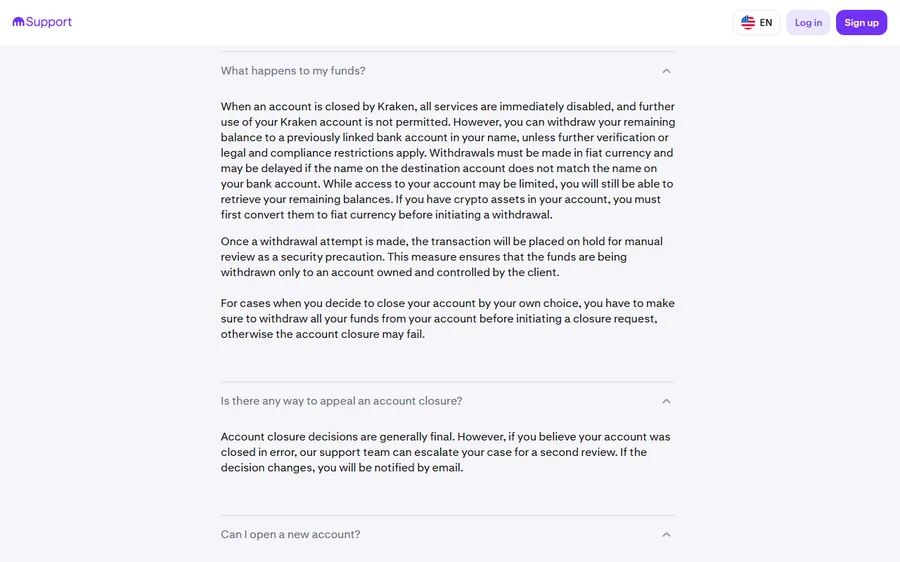
Kraken restricts the exit to fiat. The remaining balance goes “to a previously linked bank account in your name”, withdrawals “must be made in fiat currency”, and crypto “must first” be converted. Two further rules slow it down: the withdrawal “will be placed on hold for manual review as a security precaution”, and it “may be delayed if the name on the destination account does not match the name on your bank account”. There is no deadline on the page, but there is also no promise about how long the balance stays retrievable.
Coinbase allows both forms of exit and no conversion between them: a cash balance withdraws to a verified bank account, crypto is sent to an external wallet, and the exchange “does not provide conversion services for closed accounts, or allow you to sell your crypto for cash”. Crypto leaves as crypto. The page points to an unclaimed funds policy for “how long your funds will be available for withdrawal”, which is the nearest thing to a deadline.
OKX writes its exit into the terms rather than a help page. On termination OKX returns funds less any fee discounts, rebates, costs or damages it is entitled to, and asks for “a valid wallet address for transfer of any remaining Digital Assets” within 30 days of its request. If none arrives, the user has authorised OKX “to liquidate the Digital Assets in your Account and return your funds (less costs and fees) to any bank account linked to your Account”. The terms also reserve the right to keep holding assets “if required under any Applicable Laws and Regulations”. Answer the request for an address inside the 30 days, with an address you control.
Closure or restriction: read the message first
Not every alarming message is a closure. A withdrawal suspended after a password change, an account “temporarily disabled”, a verification sent back for more documents, all of these end with the account working again, and they are covered in withdrawal suspended or account restricted. Coinbase’s own wording separates the two: the “Sorry, account temporarily disabled” message is a restriction that “may be temporarily disabled or restricted for various reasons”, can be “auto removed”, and otherwise clears through a review that “typically takes up to 10 business days”. A closure is different in kind. Binance’s notice says the platform “is no longer able to provide services to you”; Kraken’s page says “further use of your Kraken account is not permitted”.
If the message gives a date by which to withdraw, it is a closure. If it tells you to try the action again later, complete a verification, or wait for a review, it is a restriction. Treat the first as a deadline and the second as a queue.
Account closed with no reason given: why exchanges do not explain
Two of the four say outright that they will not explain. Binance: “Binance may not be able to share the reason behind account deactivation due to regulatory requirements.” Kraken: “due to privacy and security reasons, we cannot disclose any details regarding account closures”, and the page adds that “this policy applies across all our support channels, including Reddit”. OKX’s terms allow termination “at any time and for any reason, at our sole discretion”, and list the grounds for suspension and investigation in general terms: suspected breach of the terms or of its anti-money-laundering programme, a balance that needs reconciling, suspected unauthorised access, or an account that is “the subject of an investigation or official inquiry by any law enforcement or regulatory authority”. Coinbase’s closure page gives only the category, “violating the user agreement”.
The practical consequence is that a closed account does not come with a list of things to fix. Where an appeal exists, it is for closures made in error, and it asks you to state your case without knowing the reason. Set out plainly what the account was used for, where its funds came from, and anything unusual that might have been misread, such as a login from abroad or a deposit from a new source. The source-of-funds documents listed in Binance asks for source of funds are the kind a review would want to see.
Can you appeal when an exchange closes your account?
Binance’s page does not use the word appeal. It says that if you have “any concerns or questions regarding this decision”, you contact support, and “we will ensure these are forwarded to the appropriate team for further review”. That is the whole route: a message, forwarded, reviewed. Kraken describes the same thing more precisely. Decisions “are generally final”, but “if you believe your account was closed in error, our support team can escalate your case for a second review”, and “if the decision changes, you will be notified by email”. Silence means the decision stood.
Coinbase’s closure page describes no appeal; its restriction page describes a resolution process for temporary restrictions, which is a different situation. OKX’s terms describe no appeal either. On both, the route is a support ticket.
Nothing on these pages says that an appeal pauses the clock. Binance’s deactivation date passes whether or not a review is open, and OKX’s 30-day request for an address runs regardless. Withdraw first, then argue.
Can you open a new account after the exchange closed yours?
Binance says no in two places. The deactivation page’s answer to “Can I create a new Binance account?” is that “each customer is only allowed to have one verified Binance account”, so a new one cannot be verified. Kraken says that if the account “was closed by Kraken, opening a new Kraken account is not permitted”, with reinstatement possible only if the appeal succeeds; the same page notes that someone who closed their own account can reopen it or create a new one whenever they like. OKX puts the rule in the eligibility clause of its terms: by using the platform you warrant that you “have not previously been suspended or removed”. Coinbase’s page does not address it.
The mechanism behind all of this is the verified identity, which the exchange keeps on file after closure and matches when a new account tries to verify. How that works, and what the waiting periods are after a closure you chose yourself, is in one account per person and same ID after closing. Binance and Kraken describe no waiting period after a closure they imposed; no end date is given, and Coinbase and OKX do not say.
Transaction history, personal data and the Web3 wallet after closure
Three of Binance’s answers concern what the exchange keeps. Transaction history and statements can be extracted only by logging in, so they belong inside the withdrawal window; the steps for each exchange are in export your trade history. Personal data is retained after closure for as long as anti-money-laundering and similar laws require, and deleted “as soon as the mandatory retention period stipulated under the applicable laws expire”, so a request to delete it is granted only in part. And the Web3 wallet, which is a separate key, can be moved rather than emptied: the page describes an “Emergency Export” that imports the wallet into another platform while keeping the same address.
Kraken’s page adds a note for the other direction. Someone who closed their own account and changed their mind “can request to have your account re-opened” through the support form by selecting “Reopen a closed account”. That option is for voluntary closures only.
Services that promise to reverse a closure
A closed account attracts offers: a contact inside the exchange, a service that lifts bans for a fee, a form to fill in that asks for the login. None of the four pages describes any route other than their own support channel, Kraken explicitly includes Reddit in the channels where it will not discuss closures, and the one piece of information the exchanges do not share, the reason, is the one these services claim to know. Spend the window on the withdrawal.
Exchange help pages and terms used · checked October 2026
Binance’s rules, including the deactivation date, the list of unavailable products, the BNB conversion, the loan and derivatives handling, data retention and the one-account answer, are from Why Did I Receive an Account Deactivation Notice? (updated 13 May 2026). Kraken’s fiat-only withdrawal, manual review, non-disclosure, second review and new-account rule are from Account Closures: Safeguarding Our Clients and Kraken (updated 28 September 2026). Coinbase’s closed-account exit is from How to withdraw funds from a closed account, and its restriction wording from “Resolve your account restriction”; neither page shows an update date. OKX’s termination, 30-day address request, liquidation, suspension grounds and eligibility warranty are clauses 2.1, 5.4, 7.6 to 7.9 of OKX’s Terms of Service (last updated 17 September 2026), the base terms that apply unless the Local Terms for your jurisdiction say otherwise. None of these pages says how often closures happen or what triggers them in a given case.